Your company's knowledge, answering with sources.
The documents exist but can't be found. The data exists but can't be read. We make your scattered internal information searchable — and build a system that answers with citations showing exactly where each answer came from.
- Cross-search with pgvector + RAG
- Answers with citations
- Natural-language reports from data
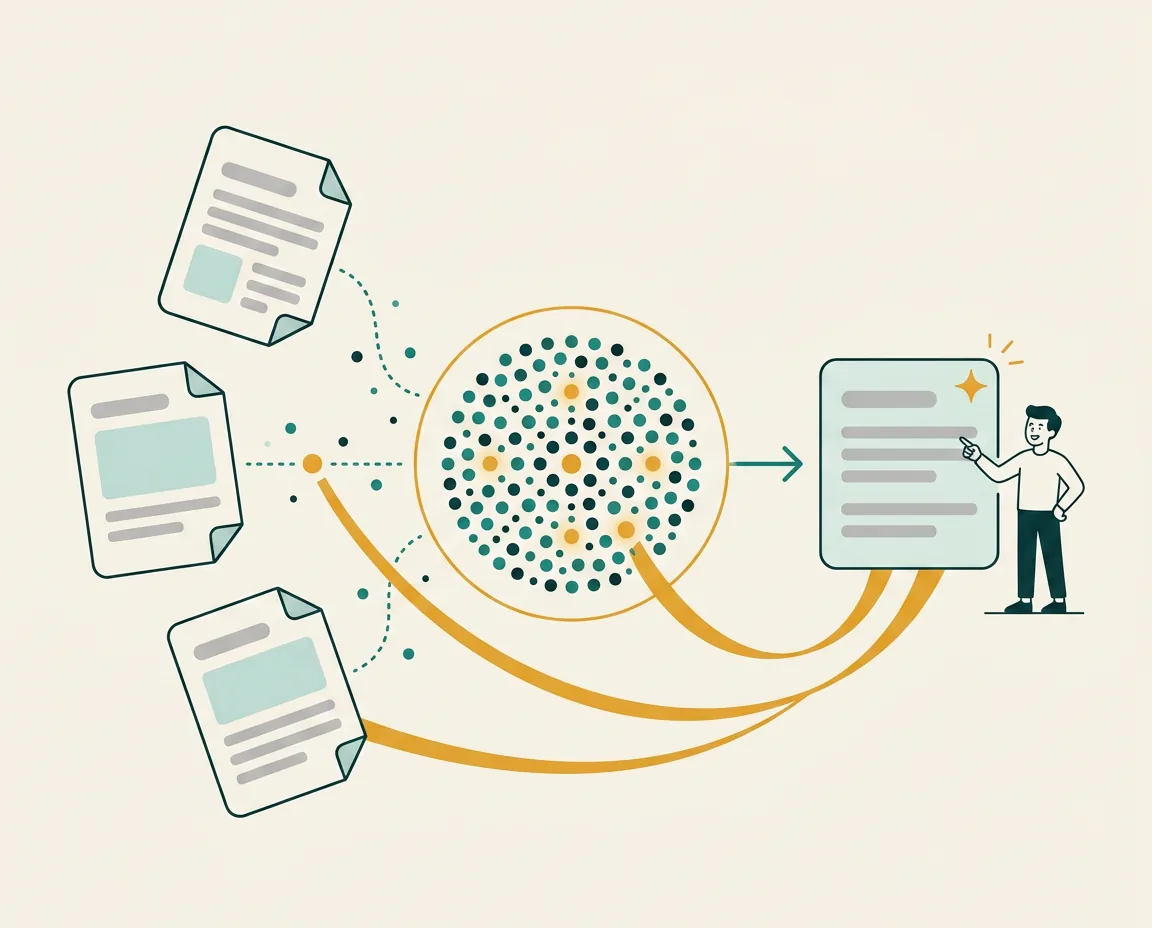
How much of the org's time goes to just searching?
The information exists — it just can't be used. Dormant knowledge and data quietly become a serious cost.
Scattered and unfindable
Drive, wiki, chat, email. Every day, time disappears into hunting for documents that exist somewhere.
The same questions, again and again
Questions pile onto the few people who know — even though the answers were written down long ago.
Knowledge leaves with people
Know-how lives in individual heads and local folders, and vanishes with every transfer or departure.
Data that can't inform decisions
The data has accumulated, but every aggregation is manual work — and answers arrive too late to matter.
From ingestion to answer, evidence stays attached.
Not an AI that returns plausible-sounding answers — a retrieval system that shows its sources.
Ingest documents & data
Internal documents and databases are ingested and organized into a searchable vector index (pgvector).
Multi-step retrieval
Questions are decomposed and explored over multiple retrieval steps — fragments get cross-referenced, not missed.
Generate grounded answers
Answers are generated from what was found, always with links back to the source documents.
Humans verify the evidence
For decisions that matter, follow the citations straight to the original text. No black boxes.
Accuracy grows with use
Feedback on answers and newly added documents feed back in continuously, improving retrieval over time.
Every answer carries its sources. Not "because the AI said so" — verifiable, evidence first.
Retrieval quality is decided by pipeline design.
RAG isn't "plug it in and it works." We carefully build the parts that determine accuracy.
Vector search (pgvector)
A vector index on PostgreSQL + pgvector — operationally simple, and at home next to your existing data stack.
Multi-step retrieval pipeline
Question decomposition, retrieval, cross-referencing, re-retrieval — a staged design that answers what single-shot RAG can't.
Natural-language report generation
Aggregations, comparisons and benchmarks generated from your data as readable reports — great for automating recurring reporting.
Permission-aware search scope
Visible only to those who should see it. Search scope follows your existing access design.
What an engagement delivers.
Not just a search box — a system built to stick inside your organization.
Cross-search & Q&A system
A retrieval foundation that answers across documents and data, with evidence attached.
An ingestion pipeline
New documents keep flowing into the index automatically — built for continuous operation.
Automated reports
Recurring aggregations and comparisons generated from data as natural-language reports.
Permission design
Who can search what, designed and implemented.
Operations documentation
How to add data sources and change settings — ready to hand over internally.
Ongoing support
Post-launch accuracy tuning and expanding the data covered.
Turn searching time into doing time.
Tell us where your information lives and the questions people keep asking, and we'll propose the highest-impact starting point. Start with a free consultation.